Broadening the Binary: Critiquing and Extending Jeremy M. Weinstein’s Theory on Rebel Behavior
Olivia Cao
Government Department, Dartmouth College
GOVT 50.19: Development Under Fire
Professor Jason Lyall
October 10, 2025
There are a host of theories that aim to explain the emergence and persistence of insurgencies. Jeremy M. Weinstein’s Inside Rebellion: The Politics of Insurgent Violence presents one such theory. Weinstein proposes that rebel groups’ initial mobilization strategy shapes other rebel behaviors, including violence, organization, recruitment, and durability. It’s a thoughtful theory, to be sure. Constructed of only two frameworks – economic and ideological endowments – the model is simple enough for in-depth analysis into both categorizations, and yet it’s exactly this binary nature that begets the theory’s primary deficiency: its inflexibility. The model rests on the idea that rebel behaviors are dictated by their initial endowments; there is no room for the insurgent groups to adapt. By eliminating the possibility of change, Weinstein fails to consider the impact of outside actors – including civilians and the state – and the ultimate implications a static characterization of rebel groups has on effective aid and counterinsurgency implementation. This paper will provide further insight into these critiques while also leveraging critical nuances of Weinstein’s theory as the foundation for a more flexible model of insurgent characterization.
Given how fundamental malleability is to insurgency survival, the inflexibility of Weinstein’s theory isn’t just impractical; it’s counterintuitive. By Weinstein’s own admission, “war is a dynamic process,” and yet he applies this characterization selectively (Weinstein, 2006, p. 45). While he notes that wartime dynamics may influence how leaders strategize to retain their base of support, his strict adherence to a static model is more concerned with “provid[ing] an enormous amount of analytical leverage for understanding the different strategies groups pursue” than reflecting reality (Weinstein, 2006, p. 50). Yet, the reality is, the context in which insurgencies develop necessitates adaptability. Particularly when navigating the unstable environment of a weak state, priorities – and by proxy, behaviors – must shift in the face of changing circumstances. If a new counterinsurgency method emerges to combat insurgent efforts, if obtaining resources becomes a critical factor to rebel success, if rival groups or civilians challenge insurgent authority, the ability to both accommodate to and learn from the situation at hand is key to resilience; without that flexibility, rebel groups likely wouldn’t have been able to avoid decimation in their rise to insurgency, never mind survive long enough to be considered a threat. The stagnancy underlying Weinstein’s theory thus becomes possible only when outside agents (state actors, civilians) are weak enough that insurgencies are able to survive without adapting.
Weinstein doesn’t just underestimate external agents, though; he fails to account for civilians and state actors entirely. In Inside Rebellion, Weinstein’s characterization of civilians is rooted in helplessness. They are “drive[n] into the waiting arms of rebel groups,” or in the face of brutal counterinsurgency, left with “no other option than to join the insurgents or to live behind guerrilla lines” (Weinstein, 2006, p. 37). He depicts civilians as passive victims of their own abuse, deprived of any individual agency. In reality, however, civilians exert their own kind of power. As a third party able to move between state forces and rebel groups, civilians are not limited to joining the insurgency or counterinsurgency armies; some choose to flee, join local militia counterinsurgency groups or otherwise counter-mobilize, or even engage in passive resistance. Interestingly, Weinstein applies this same dismissive attitude to state actors. In the few instances they are mentioned, they are framed as abusive counterinsurgents, with little mention of the role they play in aid provision or civilian interaction. By discounting their significance within insurgent conflicts, Weinstein’s theory doesn’t just do civilians and state actors a disservice; he ignores the impact that these key players have on rebel group behavior.
The holes in Weinstein’s theory – whether its insistence on an unchanging model of rebel behavior or the underestimation of civilian and state actors – have serious implications for the administration of effective aid. Weinstein’s theory has the potential to be incredibly informative for the application of counterinsurgency measures; in ascertaining an accurate prediction of rebel violence and recruitment patterns, programs can be tailored to target groups vulnerable to recruitment. Weinstein’s refusal to acknowledge change in rebel group behavior, however, severely undermines that potential, opening the door to false characterizations of insurgencies and consequently, the misguided implementation of aid and counterinsurgency strategies.
Consider, for example, a situation in which analysts, using Weinstein’s theory, characterize a rebel group as economically endowed. This type of rebel group would likely attract membership by appealing to “short-term, material interests” (Weinstein, 2006, p. 12). Counterinsurgency/aid might then take the form of employment opportunities or other economically grounded solutions as a means of preemptively redirecting potential recruits or drawing existing members away from the insurgency. However, without accounting for change, as Weinstein’s theory prevents, the insurgency may well have altered its recruitment strategy, rendering the administered tactic ineffective at best, enabling insurgency development at worst.
In an effort to expand on Weinstein’s theory, I posit a model that conceptualizes rebel group characterization less as a binary and more as a quadrant matrix. By integrating factors from Weinstein’s framework alongside those from Ana Arjona’s theory of rebel governance, the model preserves Weinstein’s differentiation between ideological and material priorities while also permitting flexibility through the addition of two dimensions: time horizon of goals and individual vs group value orientation.
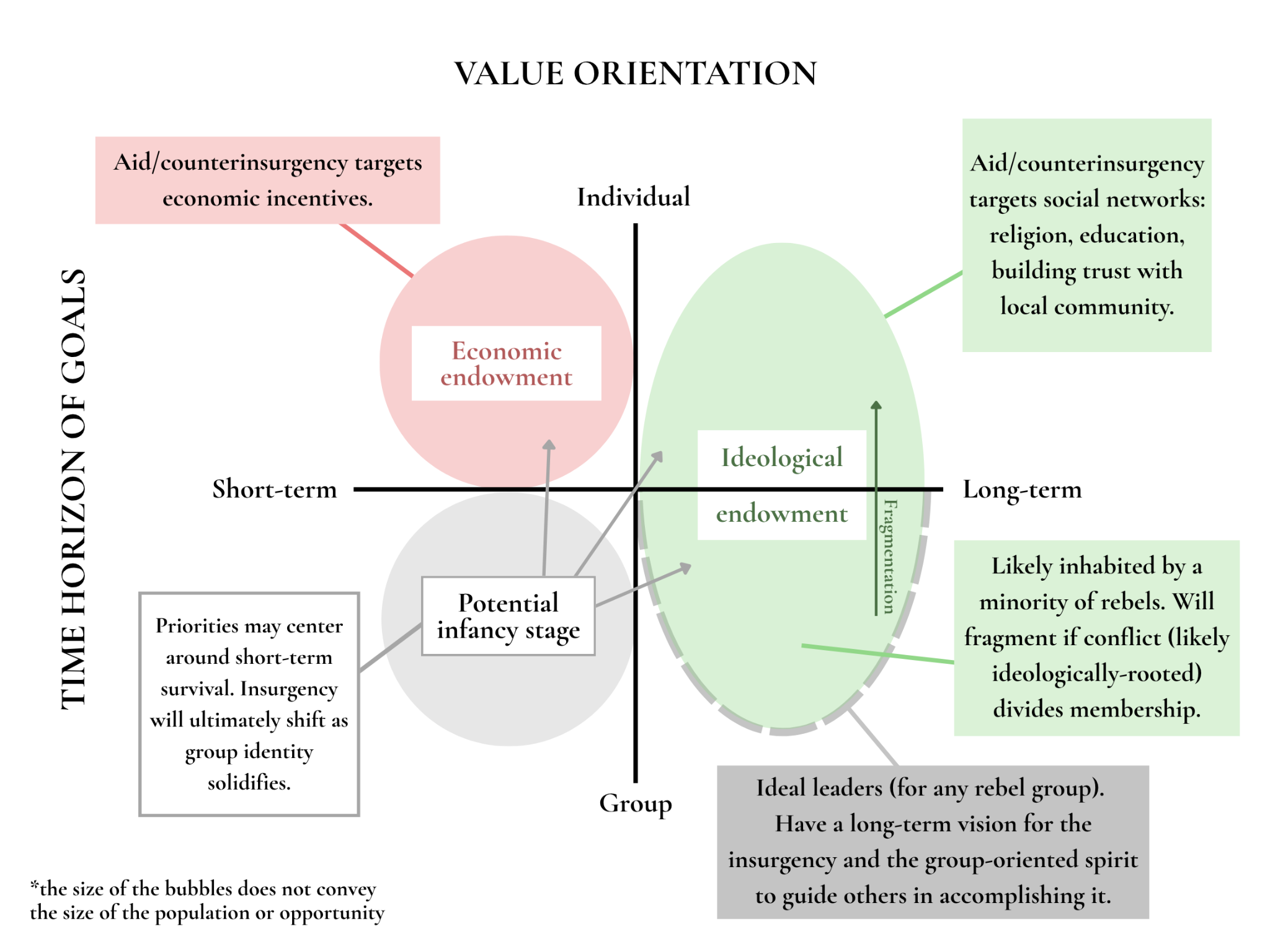
Showcased in the visual above, Weinstein’s categorizations of economic vs ideological endowments have been deconstructed into two axes. First, “value orientation” questions the centricity of the insurgency member’s values: Do they care more for their own well-being – in which case their values are grounded in the individual – or is their loyalty more group-oriented? Do their actions as an insurgent revolve around personal need or do they serve the good of the group? Second, “time horizon of goals” variable draws inspiration from Arjona’s theory of governance to consider the immediacy of a rebel/rebel group’s goals: Do “they care about future outcomes more than they do about present ones” (Arjona, 2016, p. 3)? A rebel group, or an individual member, may then be categorized into one of the quadrants in accordance with these considerations. For example, individuals who reside in the overlap between long-term goals and group-oriented values are perhaps best suited to leadership roles: They have both the long-term vision and the group-oriented drive to and make that vision a reality.
Despite its resemblance to a coordinate plane, the visual model lacks distinctly plotted points; this is intentional. Instead of reducing economic endowment and ideological endowment to singular characterizations, they are presented as zones. Through this, the theory allows for the existence of a continuum within the larger group structure; insurgency members may vary in the degree to which their motivations are self/group oriented just as they may also differ in the time frame of their goals. The model also improves upon the stringent nature of Weinstein’s theory by allowing for the maneuverability of the insurgency as a whole. In its infancy, for example, an insurgency may begin with a group-oriented motivation but a predominant focus on short-term survival; as time progresses, however, and the identity of the insurgency fully solidifies, the group may shift into a more economically or ideologically motivated mindset depending on circumstance. If an ideologically endowed group faces fragmentation, for instance, each faction may prioritize upholding their own individual perspectives in the short term before returning to a more group-oriented mindset if they should stabilize – albeit in separate groups. The model allows for both of these phenomena, precisely because it lacks a binary structure.
The model’s acknowledgement of the nuances existent in rebel groups thus enables potentially more accurate characterizations. This may, in turn, lend itself to use as a framework for effectively countering insurgency recruitment. Following similar guidelines as Weinstein’s model, more economically endowed insurgencies may attract those who seek material reward which may be countered with economic incentives. Conversely, recruitment into ideologically endowed insurgencies may be combatted with a greater focus on influencing the local community and targeting at-risk individuals through social networks. As potentially productive as this model is, however, it should be noted that its flexibility results in fewer distinct parameters for the characterization process. This may complicate the ability to clearly evaluate and correctly identify what methods of counterinsurgency/aid are most suitable, and by proxy, affect the implementation of accordingly effective programs.
While Weinstein presents a strong model for characterizing rebel organization, it ultimately fails to construct a comprehensively considerate framework. At the core of this failure are several issues, namely the exclusion of rebel dynamics in relation to state actor involvement and civilian interaction, both of which contribute to one critical absence: the ability of rebel groups to adapt. This ultimately cripples the effective application of counterinsurgency and aid strategies. Drawing inspiration from Ana Anjona’s rebel governance theory, I thus suggest a theory that extends Weinstein’s model into a more nuanced conceptualization of rebel organization, providing the foundation for a more cohesive understanding of rebel group development and, hopefully, more informed aid decision-making.
References
Arjona, A. (2016). Rebelocracy: Social Order in the Colombian Civil War. Cambridge University Press.
Weinstein, J.M. (2006). Inside Rebellion: The Politics of Insurgent Violence. Cambridge University press